
42 Tick-Tock
Wonderland Tempo: how Carroll and The Beatles play with time

Alice! A childish story take,
And with a gentle hand,
Lay it where Childhood’s dreams are twined
In Memory’s mystic band‘All in the golden afternoon’, from Alice’s Adventures in Wonderland (1865)

Time is everywhere in the Alice books. The White Rabbit clutching his fob-watch and rushing about, perpetually late. The Red Queen’s backwards logic (“sentence first–verdict afterward”). A tea party stuck at 6 O’Clock.
I can’t possibly do this topic justice in one post. As someone who wrote his PhD on the notion of ‘space’ in the Martinican novel, I’m painfully aware how much context is needed and how inadequate my account will be.
And yet…we have to start somewhere.
I think it was on a beach in Mallorca, reading Gillian Beer’s Alice in Space: The Sideways Victorian World of Lewis Carroll,1 that the penny dropped for me.
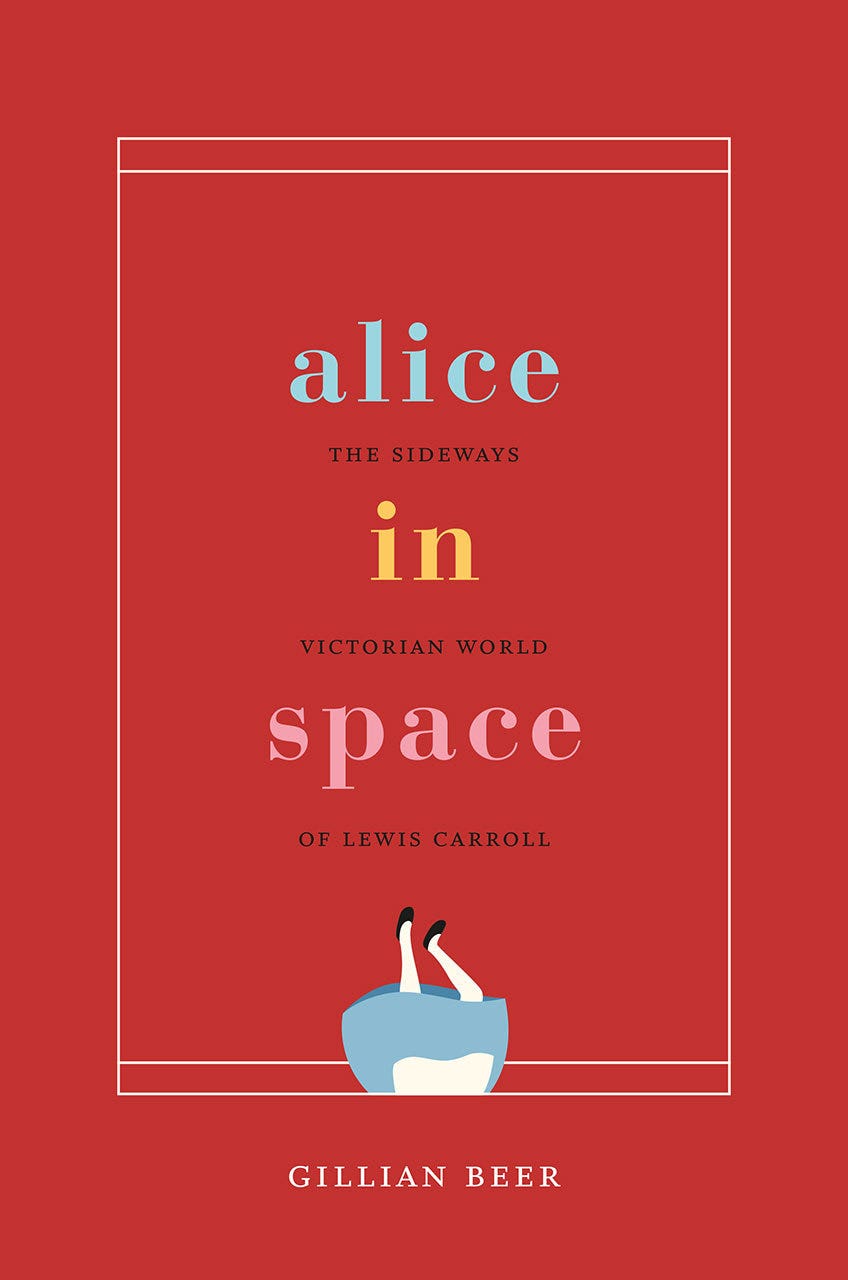
As Beer explained, part of the backdrop for Carroll’s world is the birth of standardised ‘railway’ time. In June 1841, the engineer Isambard Kingdom Brunel completed the Great Western Railway (GWR) line from London to Bridgewater, a distance of 156 miles.
For the benefit of passengers travelling on this route, the timetable carried an essential note:
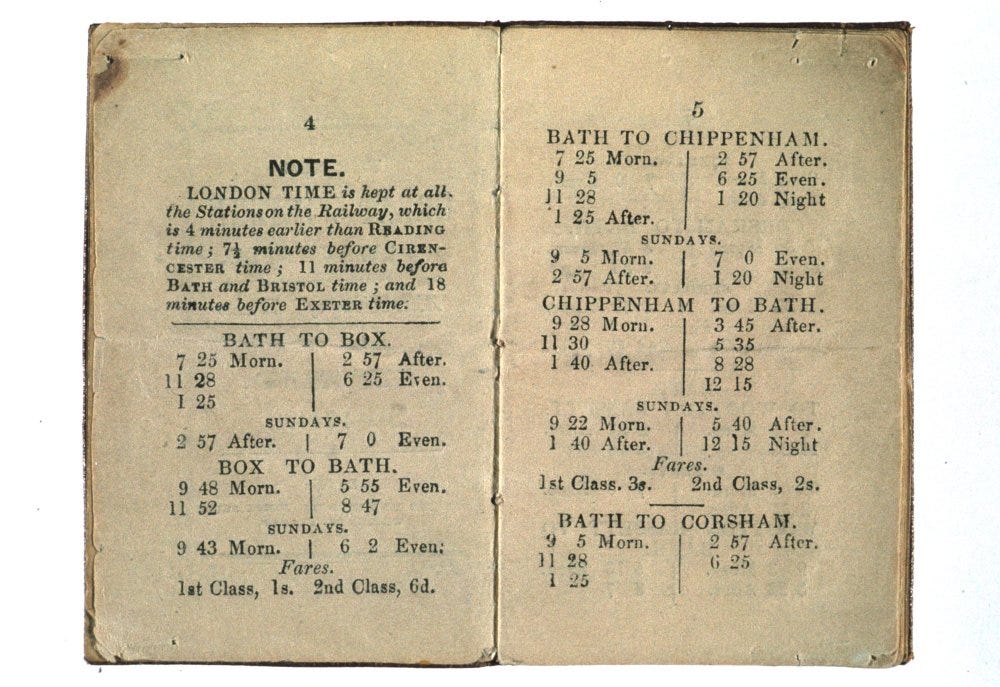
It was the first time different local mean times had been synchronised.
Of course, back in Oxford, things were different. The members of Christ Church resented the loss of Oxford’s chronometric uniqueness, and continued to conduct their affairs five minutes and two seconds behind Greenwich Mean Time (GMT). For a while, there were even two different minute hands on the tower’s clock face: one for Christ Church’s own personal time zone, and one for everyone else.2
This already sounds like the kind of debate we’d be likely to find in some corner of Wonderland, but the plot thickens. Carroll was also personally fascinated by time-paradoxes, as he outlined in an essay called ‘Where Does the Day Begin?’:
“According to the statement of ‘T. J. Buckton, Lichfield,’ the day is always commencing at some point or other on the globe; so that if one could travel round it in twenty-four hours, arriving everywhere exactly at midnight by the time of the place, we should find each place in a state of transition of name. But if for midnight we substitute mid-day we are at once involved in a difficulty.”3
-Lewis Carroll, ‘Where does the day begin?’, The Illustrated London News, 18 April 1857.
But what of the Beatles?
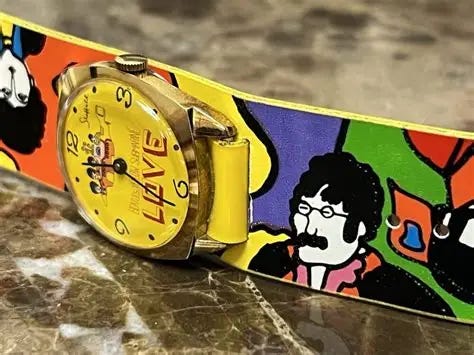
In lots of ways it’s hard to imagine a band more ‘in time’, more part of - as well as creating - their own era, and yet in their songs, in their lyrics, and in their studio experiments, as they escaped the rigours of the road, they freed themselves up to play with time in marvellous and multifarious ways.
Think vari-speed: the sped-up ‘Lucy in the Sky…’ vocals, and slowed-down ‘Rain’ backing track…
Think time-shifting: jumping up into trees in the video for ‘Strawberry Fields Forever’, backwards guitars on ‘Rain’, ‘Tomorrow Never Knows’ and many more.
Think wordplay: Ringo’s linguistic paradoxes… ‘Eight Days A Week’, ‘A Hard Day’s Night’, ‘Tomorrow Never Knows’… often with a temporal dimension.
Think dreamtime: how ‘A Day In The Life’ switches between real world and dream world, the repeated “imagine” trope…
So let’s break it down and see where Alice fits in.
Tempo 1
THE TYRANNY OF CLOCK-TIME:
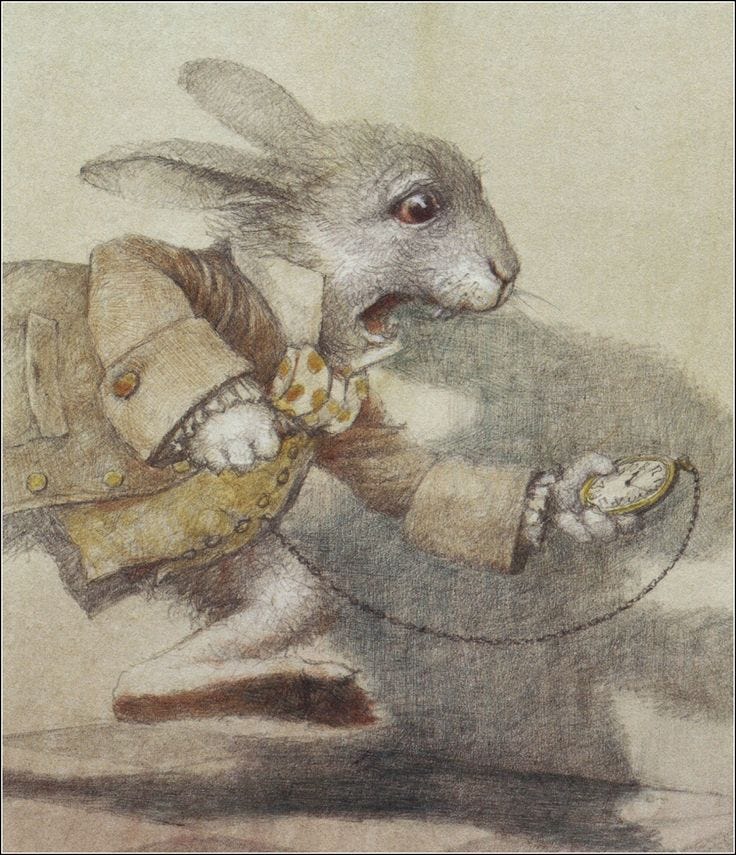
Enter our old friend the White Rabbit, emblem of the external world, bureaucracy, and the pressure of conformist time.
‘Oh dear! Oh dear! I shall be late!’ […] the Rabbit actually took a watch out of its waistcoat-pocket, and looked at it, and then hurried on
-Lewis Carroll, Alice’s Adventures in Wonderland, ch.1
The Beatles exist in 1960s time, but their musical world is often reflective, out of time.
In ‘Fixing A Hole’ (1967) McCartney critiques the rat race, where “silly people run around”…. in favour of slowing down, “taking time for a number of things that weren’t important yesterday”. And later on Sgt Pepper’s, contrasting with Lennon’s woozy dream-world, McCartney dramatises early memories of being late, as an alarm clock kicks off:
Woke up, got out of bed
Dragged a comb across my head
Made my way downstairs and drank a cup
And looking up, I noticed I was late
Found my coat, and grabbed my hat
Made the bus in seconds flat
Found my way upstairs and had a smoke
And somebody spoke and I went into a dream
’A Day in the Life’ (1967)
We move between an insistent, time-marking, bass and onto the inexorable orchestral climb, blurring our sense of bar lines and ending on the crashing, end-of-world, piano chords that seem to go on forever.
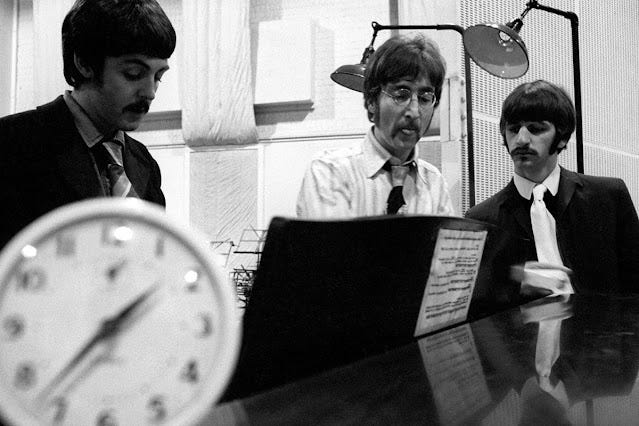
It’s not the first or last time.
Lennon was known for loving his duvet time. We see it on Revolver with ‘I’m Only Sleeping’:
Everybody seems to think I'm lazy
I don't mind, I think they're crazy
Running everywhere at such a speed
'Til they find there's no need (there's no need)‘I’m Only Sleeping’ (1966)
It’s also an early taste of Strawberry Fields, where “nothing is real”: John’s mental happy place, that’s contrasted with the external world of ‘normality’ and expectation. Where John’s reveries feel right, it’s the external world that’s “crazy”. No wonder that the Beatles use backwards video to emphasise the strangeness of that duality.
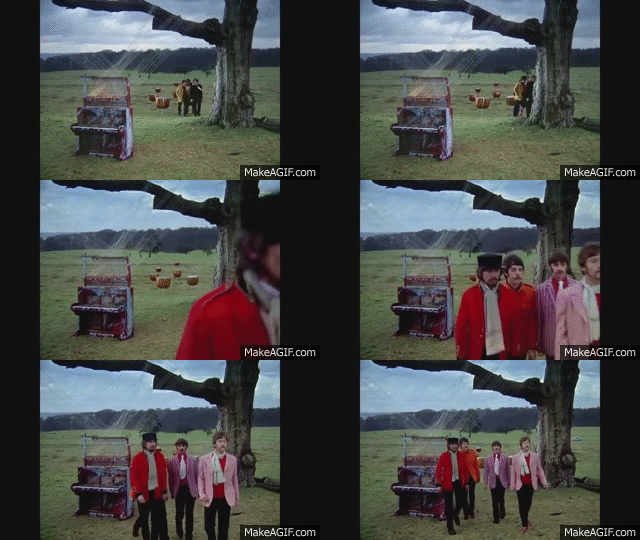
Again, with ‘I’m So Tired’ (1968), the conflict comes from within, from John’s brain, seemingly unable to settle or slow down:
You know I can't sleep, I can't stop my brain
You know it's three weeks, I'm going insane
You know I'd give you everything I've got for a little peace of mind‘I’m So Tired’ (1968)
If peace is found in the arms of Morpheus - the prince of elastic time - it’s the monkey mind of the present that comes to disturb it.
Tempo 2
NOSTALGIA & ‘MEMORY’S MYSTIC BAND’
The Beatles are often celebrated for experimentation, for their modernity, and disregard for norms, yet where they depart from their Californian psychedelic counterparts is in their nostalgic moments.
It’s explicit in Paul’s ‘Granny Songs’, harking back to previous musical styles, from ‘When I’m Sixty-Four’ to ‘Honey Pie’ to ‘Your Mother Should Know’, and enshrined in Sgt Pepper’s visual Victoriana:
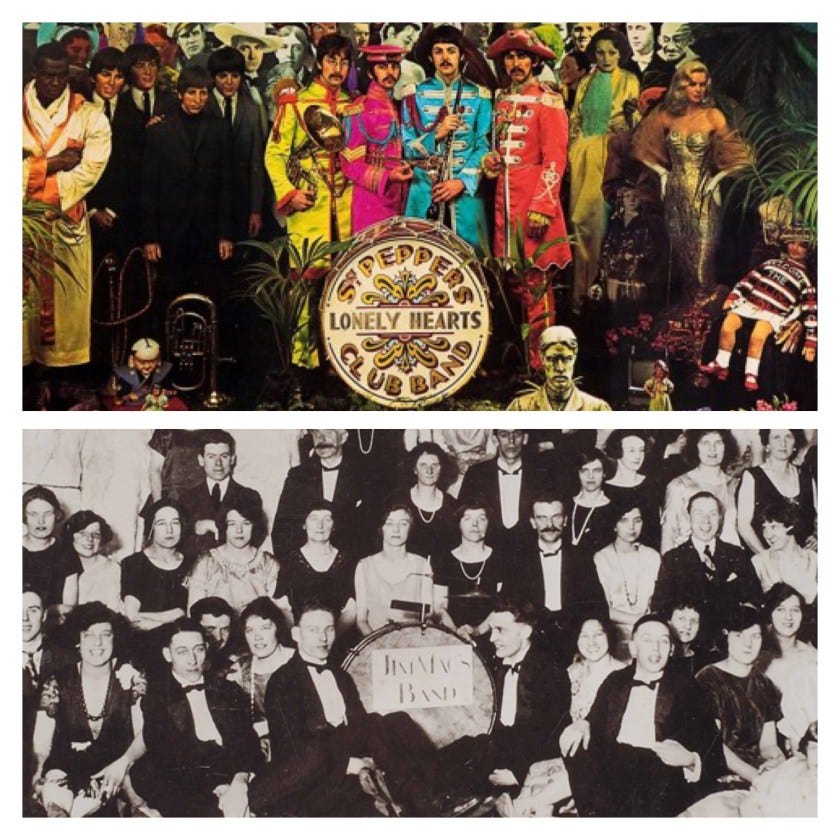
As much as they looked forward and outwards, the Beatles loved to look back, to play with pivots. We see it in ‘Things I Said Today’ (past and present fusing into a single statement), it’s, and it’s most obvious in the past / present (yesterday / now) framing of ‘Yesterday’:
Yesterday, all my troubles seemed so far away
Now it looks as though they're here to stay
Oh, I believe in yesterday
There are also generational dynamics at play: ‘She’s Leaving Home’ dramatises the psychodrama of youth culture butting up against pre-War attitudes.
But it’s not just Paul.
There are Ringo’s temporal jokes: ‘Eight Days A Week’, ‘A Hard Day’s Night’ and ‘Tomorrow Never Knows’. And ‘In My Life’ is a look-back that’s striking for a 20-something, a little like Joni Mitchell’s ‘Both Sides Now’.
There are places I’ll remember
All my life, though some have changed
Some forever, not for better
Some have gone and some remainAll these places have their moments
With lovers and friends I still can recall
Some are dead and some are living
In my life, I’ve loved them all
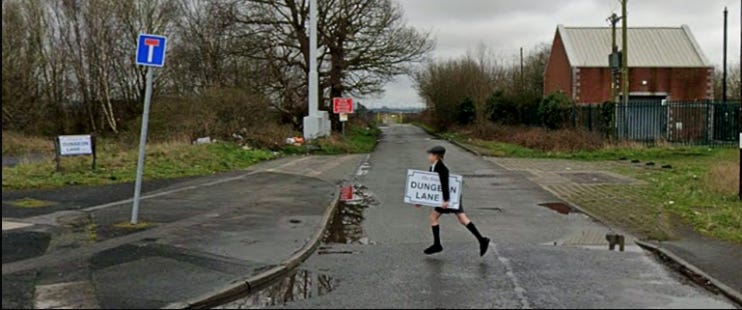
As we write this, McCartney, now 83, has just released his latest piece of backwards reflection, ‘The Days We Left Behind’, in which he remembers his 10-year old self, playing on the Mersey Shore, near Dungeon Lane:
Looking back at white and black
Reminders of my past
Smoky bars and cheap guitars
But nothing built to last
Nothing ever stays
Nothing comes to mind
No-one can erase
The days we left behind-Paul McCartney, ‘The Days We Left Behind’ (2026)
As some have pointed out, it’s like a ‘When I’m 64’ in reverse. In a lovely piece of inventiveness, an image of a 10-year old boy has been placed inside Google Maps to create a piece of marketing time travel:
Tempo 3
THE TIMELESSNESS OF TEA-TIME
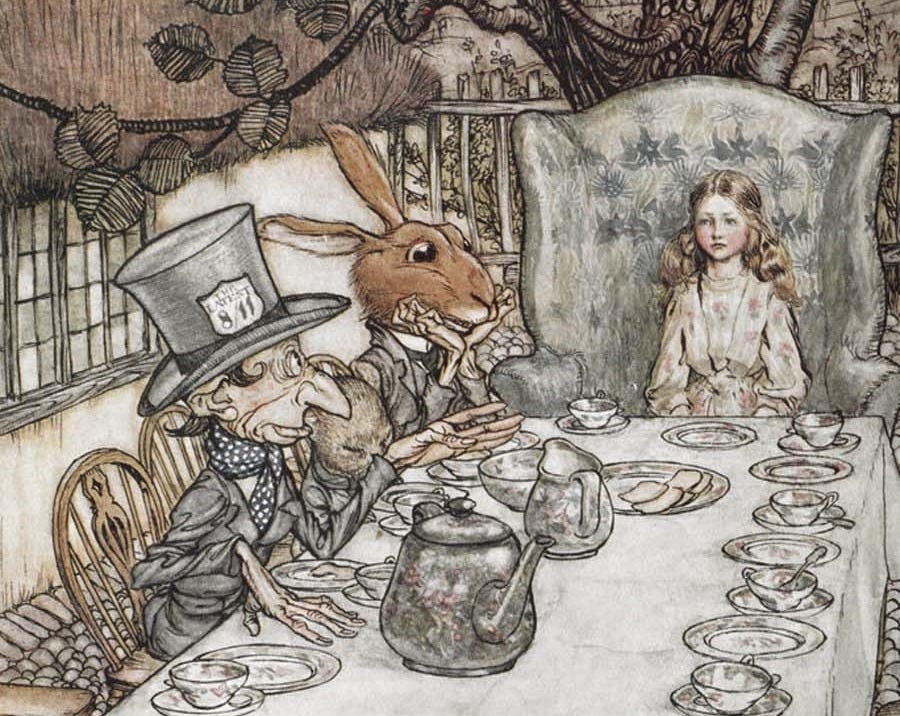
Tea-time in Alice is a running joke with some serious undertones. While the Hatter episode is a chance for some verbal punning - about “murdering time” and “beating time” (metaphors taken literally), it’s also a chance to explore the subjectivity of time (personal v clock time).
Alice sighed wearily. “I think you might do something better with the time,” she said, “than waste it in asking riddles that have no answers.”
“If you knew Time as well as I do,” said the Hatter, “you wouldn’t talk about wasting it. It’s him.”
“I don’t know what you mean,” said Alice.
“Of course you don’t!” the Hatter said, tossing his head contemptuously. “I dare say you never even spoke to Time!”
“Perhaps not,” Alice cautiously replied: “but I know I have to beat time when I learn music.”
“Ah! that accounts for it,” said the Hatter. “He won’t stand beating. Now, if you only kept on good terms with him, he’d do almost anything you liked with the clock. For instance, suppose it were nine o’clock in the morning, just time to begin lessons: you’d only have to whisper a hint to Time, and round goes the clock in a twinkling! Half-past one, time for dinner!”
Lewis Carroll, Alice’s Adventures in Wonderland (1865), ch.7
With Revolver, and their escape from the clock-time of touring, and endless press commitments anchoring them to the present, the Beatles’ interest in alternative relationships with fixed time grow.
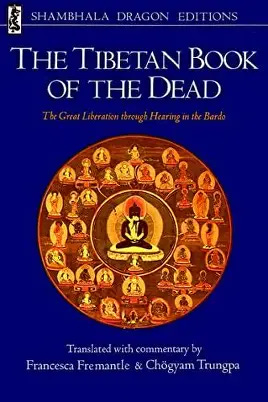
John’s chance discovery of the Tibetan Book of the Dead, at the Indica Gallery / Bookshop, sparks a process of playing with time tunnels and looping. ‘Tomorrow Never Knows’ (1966) has a title that itself is a temporal paradox (thanks to Ringo) and an opening line - “turn off your mind, relax and float downstream” - that’s an invitation to escape normal time.
I see in the floating metaphor an echo of the river that sparked Alice’s journey, made sound in the song’s cycling core, an out-of-time reverie that’s a Moebius strip of language and sound:
But listen to
The colour of your dream
It is not living
It is not livingAll play the game
Existence to the end
Of the beginning
Of the beginning-Lennon & McCartney, ‘Tomorrow Never Knows’ (1966).
As John intones his Dalai Llama incantation, with its insistent and never-changing drum, bass and Tampura drone, varisped tape-loops fly in and out over pedal bass textures, creating a tapestry of sonic strangeness that still sounds futuristic today.
It’s a sound and theme that George will pick up in 1967’s ‘Within You Without You’, his exploration of Eastern time and consciousness:
Try to realise it's all within yourself
No one else can make you change
And to see you're really only very small
And life flows on within you and without you
Like John’s psychedelic manifesto, George’s makes the river into an internal flow of subjectivity and connectedness to something bigger than the self.
On the White Album, ‘Revolution 9’ stands as another timeless soundscape, a collage without a temporal line, the traditional arc of narrative time dissolving in an ever-present coming-and-going of voices and sonic fragments that blend into each other.
Tempo 4
PLAYING WITH TIME
From a group that loved a backbeat, late 60s Beatles increasingly experiment with changes; changes in size, direction and speed.
We’ve previously commented on the scenes in Yellow Submarine where time seems to go forwards and backwards simultaneously:
Old Fred: [] Now I don't mean to alarm you, mates, but the years are going backwards. George: What does that mean, Old Fred? Old Fred: It means that if we slip back through time at this rate, pretty soon we'll all disappear up our own existance! Ringo: Hey, I wonder what'll happen
-Yellow Submarine (1968)
As the Beatles age and grow long beards they come up their mirror image going in the other direction:
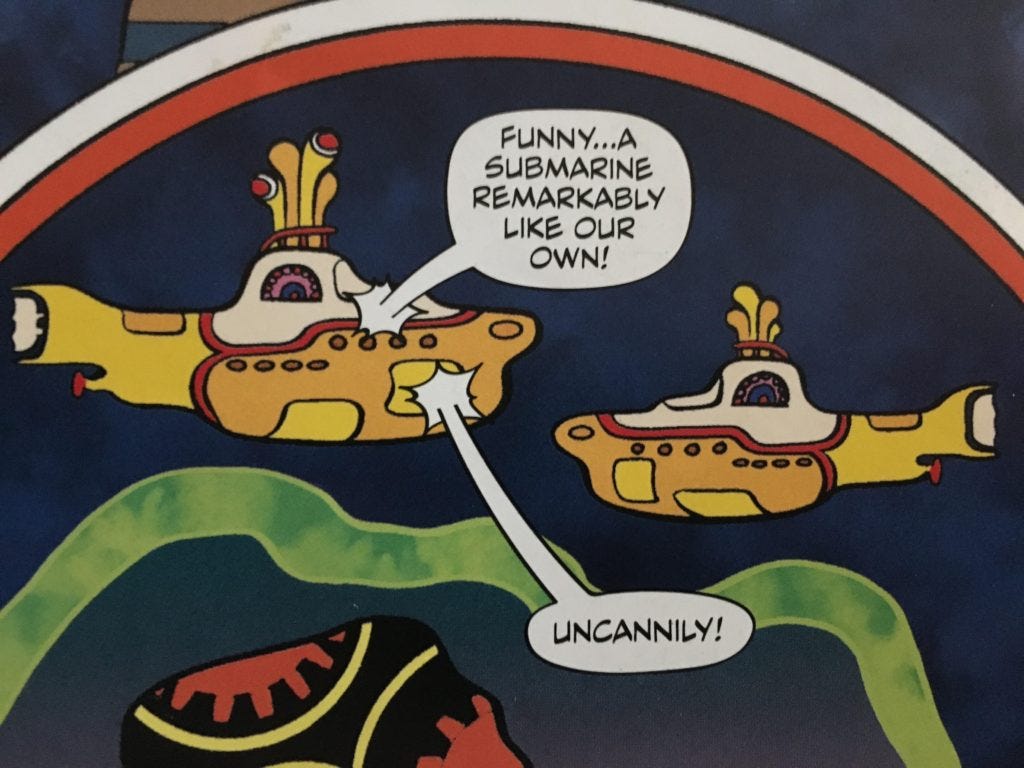
In their constant drive to innovate and create those uncanny familiar / unfamiliar experiences, the Beatles and their engineers found new ways to play with tape-speed and reverse sounds.
It’s there in the pitched up vocals on ‘Lucy in the Sky With Diamonds’, in reverse cymbals and guitars all over the 1966-7 output, in the way George Martin spliced together two takes at different speeds of ‘Strawberry Fields Forever’, in the miracle that is ‘I Am The Walrus’ and in the swampy backing for Rain (where a hyper-speed rhythm track was slowed down to create the tape equivalent of sprinting through treacle.
Just as Alice changes size and scale, so the Beatles also played with reverb, echo effects and vari-speed to create illusions of proximity and distance.
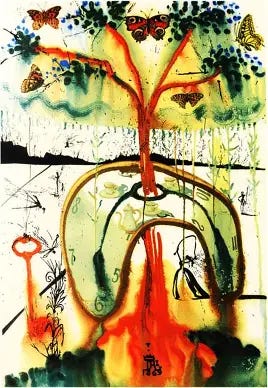
It’s a Century-long curiosity about time that stretches from Carroll’s 1860s to the 1960s. No wonder when Dali came to draw his Alice, he referred back to his melting watches trope seen in ‘The Persistence of Memory’.
This took an absolute age to write.
I hope the next one won’t be as long coming…
See you all soon.
Beer, Gillian. Alice in Space: The Sideways Victorian World of Lewis Carroll. Chicago and London: University of Chicago Press, 2016.
The time you spent to write this was well worth it. "He" would be pleased.